Tag: Mindful Moments

  • The Imperfect Pot

    The Imperfect Pot

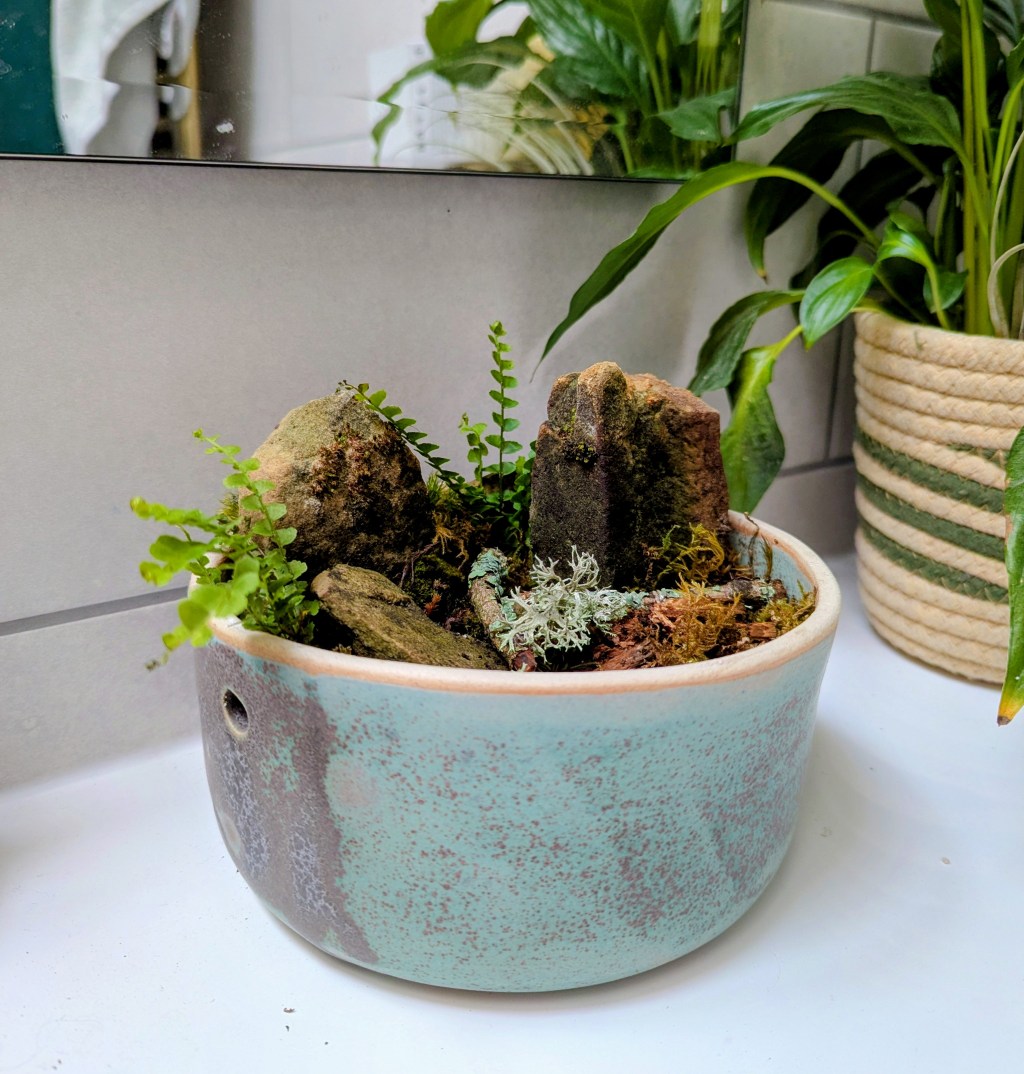
    There’s a bowl on my kitchen worktop desk that wasn’t supposed to look like this.

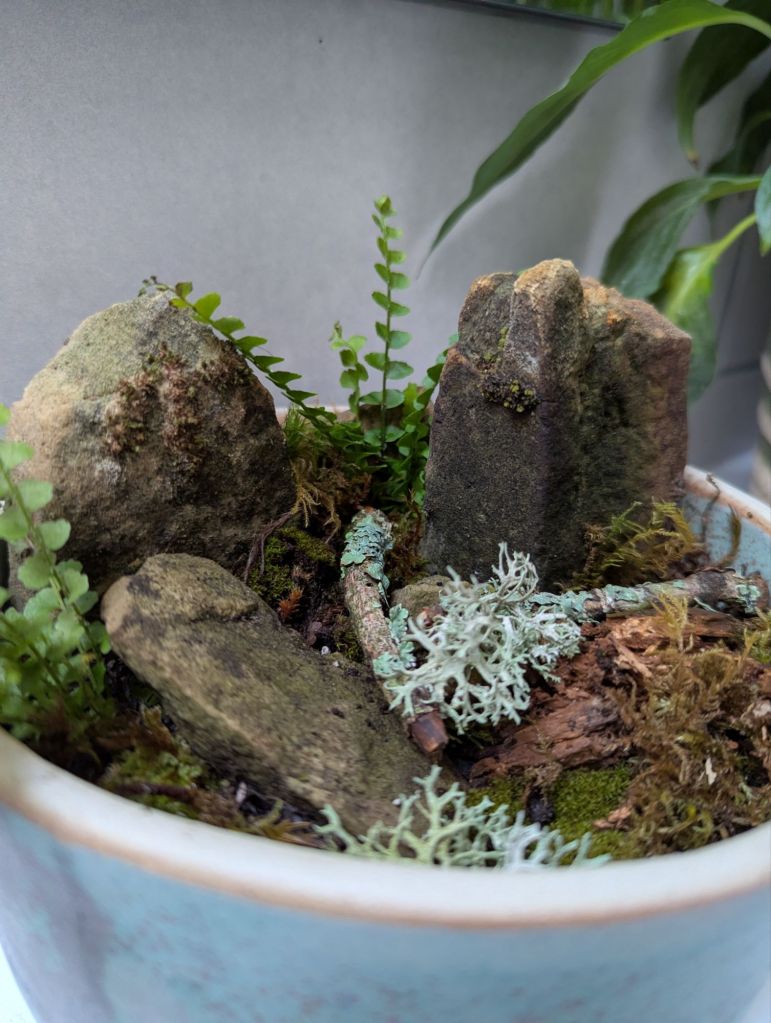
    I’m still learning to throw on the wheel, and there’s a particular stage in that process where confidence and emerging skill don’t quite meet. The form I had in mind was a hanging planter, taller and lighter. I repaired the surface cracks before the final glaze firing, but the clay had its own memory. Some of the cracks returned, and the rim distorted in the kiln, possibly as the structure shifted around them. Then during the glazing process I dropped it in the bucket, which left a heavy iron spotting across the teal surface. The result was heavier than intended, cracked, rim askew, and nothing like the hanging planter I’d imagined. But I found I liked the texture and aliveness of the final form.

    So I kept it, and it migrated around the kitchen for a while. A fruit bowl for a time, then a sink tidy. Neither felt quite right. It just sat there, waiting to become something.
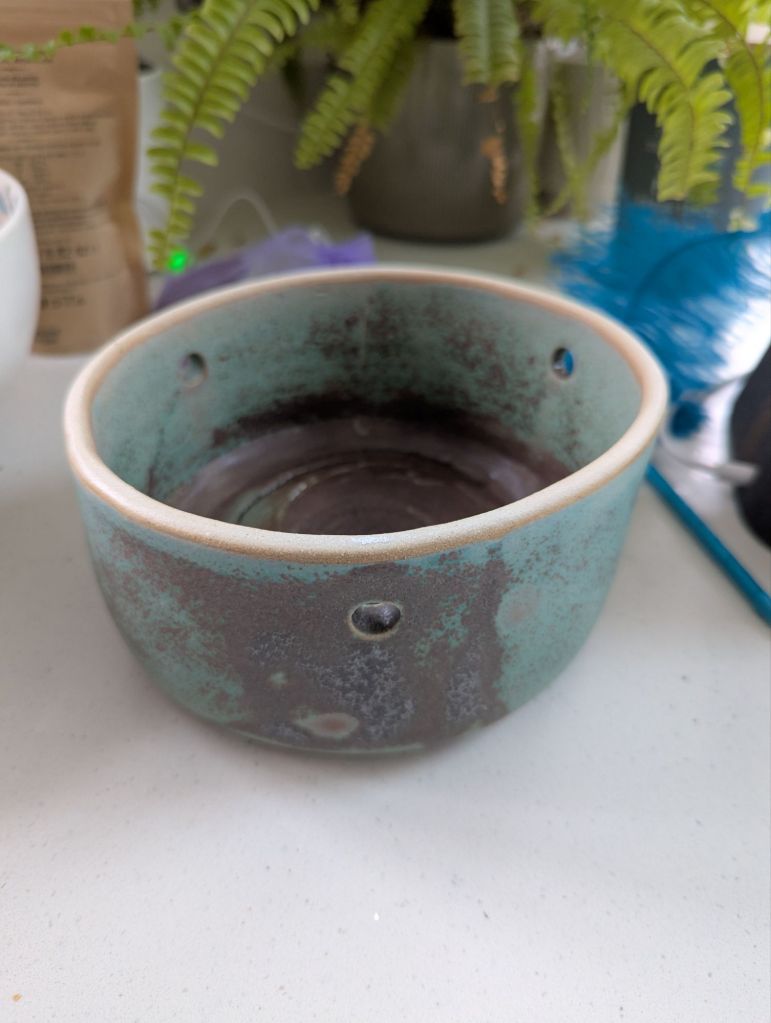
    The more I noticed it the more I started to see it differently. Less as a failed version of something else, and more as a form with its own character. The low open shape. The mottled surface that looked, in certain light, not unlike lichen on stone.

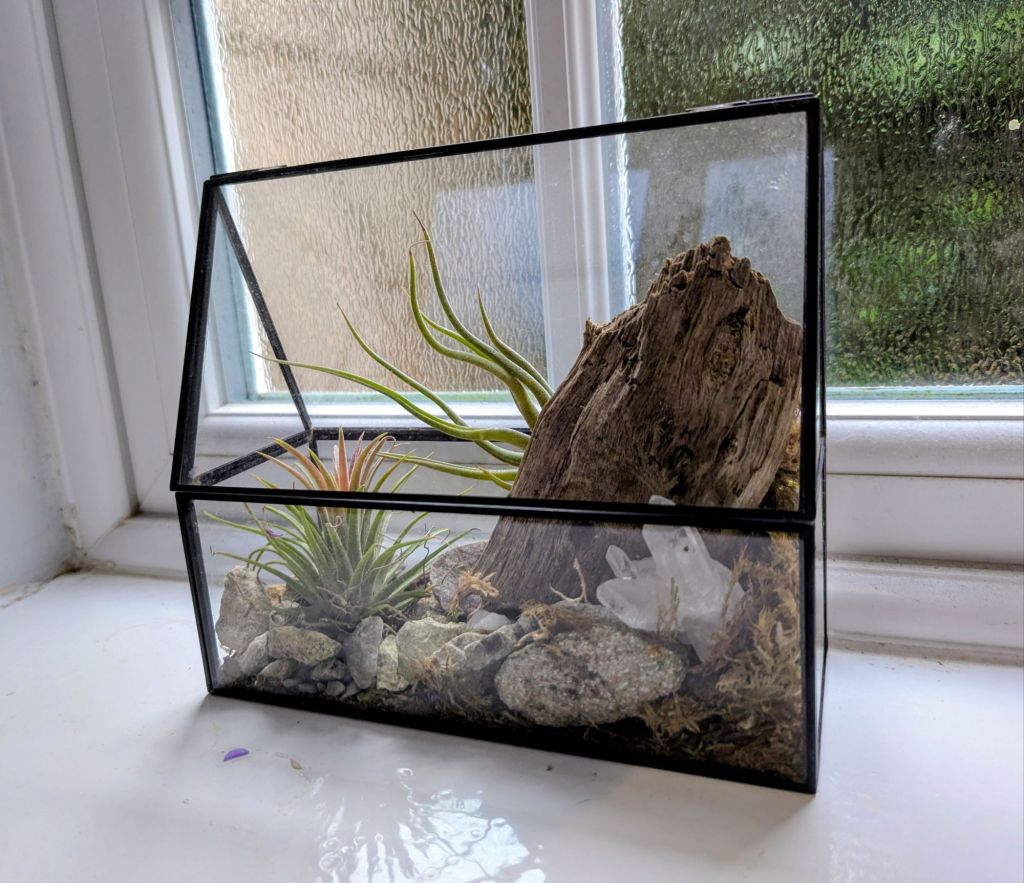
    Around the same time I’d been arranging a small landscape in a glass greenhouse on the windowsill: tillandsia, driftwood, stones from a rockery. I found the process of placing and adjusting things more absorbing than I’d expected. It suggested something to do with the bowl.
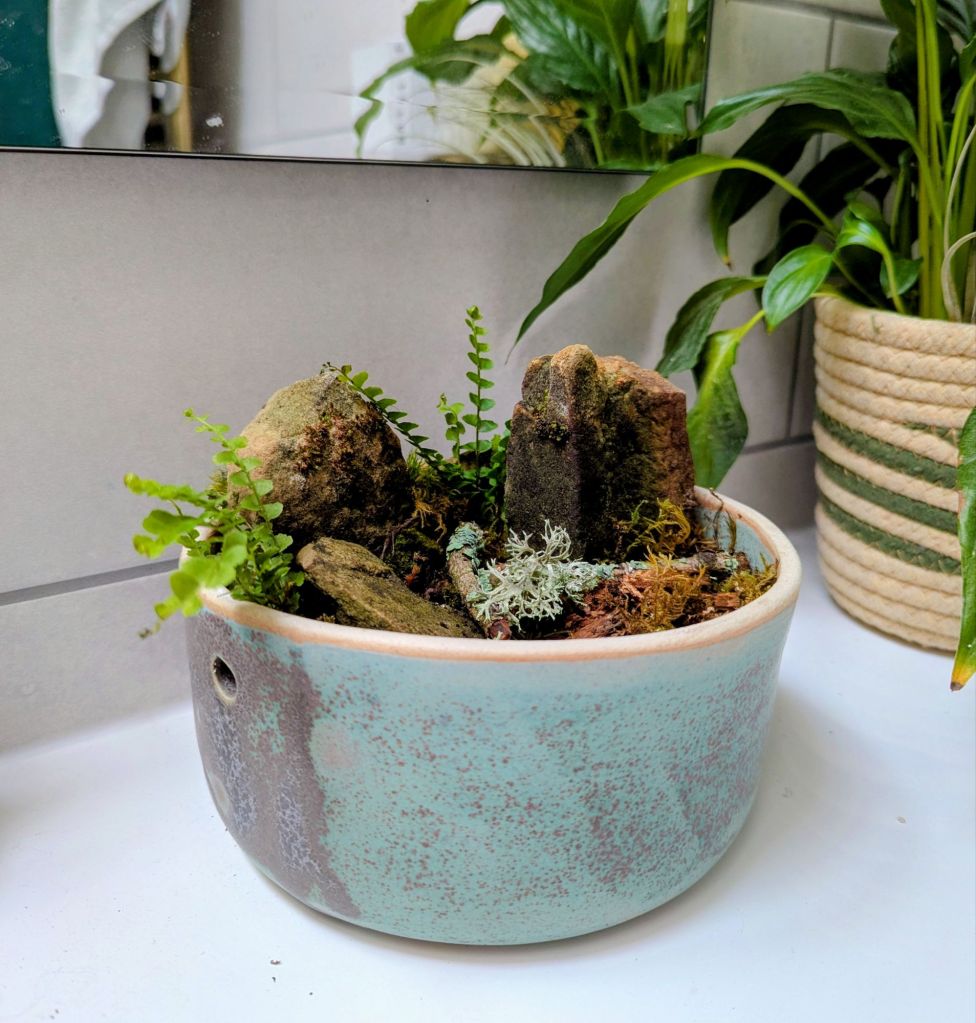
    So I began gathering from the garden: mossy stones, lichen-covered bark, fragments of wood from under the hedge, a small fern. What surprised me was how the gathering changed the quality of attention I brought to ordinary walks. I started noticing different mosses on walls, on the shaded sides of stones, at the base of trees. Not looking for anything in particular, just more open to what was there. A kind of receptive noticing, things arriving rather than being sought.

    Though gathering around my garden gave me pause too. Taking moss from a wall, lifting lichen from bark, as each small removal left something slightly less than it was. I found myself thinking that the experience wouldn’t be the same for what remained, and that if everyone did the same we would quietly erode the very thing we were drawn to. I took what felt like enough, and not more than that. But I held the question.

    There is even a whole practice around this, books like Miniature Moss Gardens by Megumi Oshima and Hideshi Kimura document the Japanese tradition of cultivating moss as a meditative and aesthetic discipline in its own right. I only came across this afterwards, which felt like a quiet confirmation rather than a starting point.

    The arranging of the pot felt similar but slightly different from the gathering. More active, but still coming from the same quiet place. Less thinking, more a sense of intuitive balance. Whether a stone felt right where it was. Whether the scale of things related to each other intuitively.
    In the Japanese calendar of 72 micro-seasons, that date falls within Shimo yamite nae izuru, ‘frost stops, and seedlings emerge.’ The point when growth is no longer at risk of being cut back before it takes hold. I didn’t know that at the time.

    Not all of the moss will survive. Some is already adjusting, and it’s not yet clear what will settle. That feels like an honest part of the experiment. Tending something living means accepting that it will change on its own terms.

    Beltane fell a few days ago, on May 1st, the old Celtic threshold between spring and summer, traditionally a time for tending and paying attention to what’s growing around you. A bowl of moss is a modest version of that. But the noticing it prompted, on walks, in the garden, at a windowsill, felt like something worth practising.
  • Lammas: Marking the First Harvest

    Today is Lammas, an ancient festival celebrating the first fruits of the harvest, a moment in the seasonal cycle where we pause to acknowledge what has begun to ripen, both in the natural world and within ourselves.

    Traditionally observed on August 1st, Lammas (from ‘Loaf Mass’) was a time when communities would bake bread from the first grain of the season and offer it in gratitude for the earth’s abundance. There is a beautiful groundedness in this ritual, a way to be present to the quiet shift from high summer toward the first whispers of autumn.

    This morning, I marked the day by making a loaf of multi-seeded bread, using a mix of organic flour, oats, pumpkin, sunflower, and flax seeds. As I kneaded the dough, I was reminded how simple acts rooted in season and intention can connect us deeply to the rhythms of life.

    Recipe from Sally’s Baking

    Out in the garden, the signs of the season are everywhere: tomatoes ripening, bees busy, seed heads forming. And yet, this year also brought loss. Our willow tree, once a soft green marker of spring and summer, didn’t survive the intense heat. Perhaps a reflection of the broader shifts we’re witnessing. Seasonal patterns altering, biodiversity changing, the climate shaping and reshaping the world around us.

    Still, Lammas holds space for all of it. The harvest and the letting go. It invites reflection:

    • What have I grown or nurtured this year?

      What is coming to fruition in my life?

      What might need to be released as the cycle gently turns toward its next phase?
    The Three Sisters (although our squash has struggled)

    These seasonal transitions remind us of the birth and death cycles always in motion not just in the land but in ourselves.

    This also brings to mind something from Local by Alastair Humphreys, a book that explores the richness of staying rooted to place. He writes about the Japanese concept of 72 micro-seasons, each lasting just five days. With names like ‘the first dragonflies appear’ or ‘dew glistens white,’ they offer a poetic reminder that change is always unfolding, even when it feels still.

    Ways to Honour Lammas:

    • Bake something seasonal – a loaf of bread, a fruit crumble, or even just toast with local honey.
    • Gather wildflowers or herbs and make a small nature altar.
    • Reflect on your own ‘harvest’. What is maturing in your life.
    • Walk slowly, noticing subtle changes: heavier air, golden fields, tired flowers.
    • Share food with others as a small act of gratitude.

    In a world that rarely pauses, Lammas invites slowness, noticing, and gentle celebration of what is already here and what is quietly changing.

  • A Quiet Encounter at the Krishnamurti Centre: Reflections from a mindful trail inward

    As part of our Mindful Trails journey exploring slow, conscious living through both outer landscapes and inner terrains, I recently spent two nights at the Krishnamurti Centre in Hampshire. This wasn’t part of a scheduled retreat, but rather a personal pause: a chance to step into stillness and see what surfaced.

    I arrived with only a vague idea of what to expect, and that openness proved to be a gift. Without structure or agenda, I found myself gradually becoming more grounded. Much of my time was spent wandering the stunning grounds and gardens, sitting beneath trees, and simply listening. Just listening.

    There are circular walks mapped out around the centre, and I ventured further afield too. Each step felt like part of a wider letting go. Foxgloves were in bloom on the route, their presence subtle yet vibrant reminding me that even beauty can whisper.

    Meals were shared communally, and while silence wasn’t a requirement, the conversations I had were spacious and intentional, rooted in insight rather than small talk. The food was wholesome and thoughtful, aligning with the atmosphere of care that quietly infused everything.

    I spent time in the library, where Krishnamurti’s writings filled the shelves in many languages. Reading his words amidst that silence felt different from reading at home. It felt embodied. Only on the final day did I visit the quiet room. Sitting there, I experienced a deeper sinking into presence, an encounter with a stillness I recognised but not connected with for sometime.

    Since leaving, I’ve noticed this silence echoing into my daily life. A subtle shift, but real a deepening of the inner trail that supports how I move through the world.

    At Mindful Trails, we often speak of slow adventures, of finding magic in the everyday, and of tuning into both the seen and unseen. This short stay felt like an inward expedition. Less about the path underfoot, and more about the one within.

    If something in this reflection resonates with you or if you’re curious and just need a gentle nudge to take your next step, please feel free to reach out. We’re always happy to share more, swap stories, or walk alongside you for a moment on your own mindful trail.

  • A Mindful Moment Between Meetings

    Sometimes, a simple lunchtime walk becomes something more.

    During a particularly difficult period in my career, I found myself pulled toward green spaces in search of a reset. These solo escapes, sometimes just 20 minutes long became something like medicine. A picnic bench under a tree. A quiet trail just past the last row of houses. A patch of forest where you could feel the day exhale.

    What started as a breath of fresh air turned into a quiet ritual. I began to spend longer in these outdoor pockets of calm, and on some days, even joined video meetings from woodland clearings or grassy meadows. To my surprise, the people on the other end of the call noticed too the sense of calm, the stillness. It became something I shared, not just something I needed.

    I also brought a sense of curiosity to these micro adventures. Using the Merlin Bird ID app to learn birdsong, or plant ID apps to explore what was growing around me, gave these moments texture and meaning. It wasn’t about covering ground it was about noticing the ground beneath me.

    These mindful moments reminded me:

    • That we don’t always need big plans to feel grounded
    • That nature, even in small doses, can be powerful
    • That connection can be found just a few steps outside the usual routine

    3 Ways to Find a Mindful Moment Near Work

    1. Go solo and slow. Take 15–30 minutes to explore nearby green space without a goal. Walk slowly, notice your breath, your senses, and your surroundings.

    2. Pack a picnic (even if it’s small). A sandwich on a shaded bench can feel like a full reset. Eating slowly, in fresh air, helps you reconnect with your body and the moment.

    3. Let curiosity guide you. Try an app like Merlin or Seek to explore the natural world around you. Notice the birds, plants, textures, and weather patterns you often miss.

    Final Thought

    You don’t have to go far to go deep. Whether it’s a patch of trees near the office or a meadow tucked behind a housing estate, these small moments can shift your perspective and your day.

    If you’ve found your own micro escapes near work, we’d love to hear them.