Tag: Mindful Walking

  • Grid Square 3: Still Waters and Secret Sets

    I began my walk at a large car park, following a wide trail skirting a cross-country horse field, where jumps lay scattered across the open space. The trail eventually led me to a large, partially fenced private fishing pond. A small plaque beside it commemorated someone who had helped establish the pond but, sadly, never had the chance to fish it. Standing there stirred memories of fishing as a teenager, of slow, sun-drenched days by the water and the quiet peace they brought.

    Crossing a narrow stream, I stepped into Ministry of Defence land a vast patchwork of terrain that, despite its primary function, forms an important sanctuary for biodiversity.
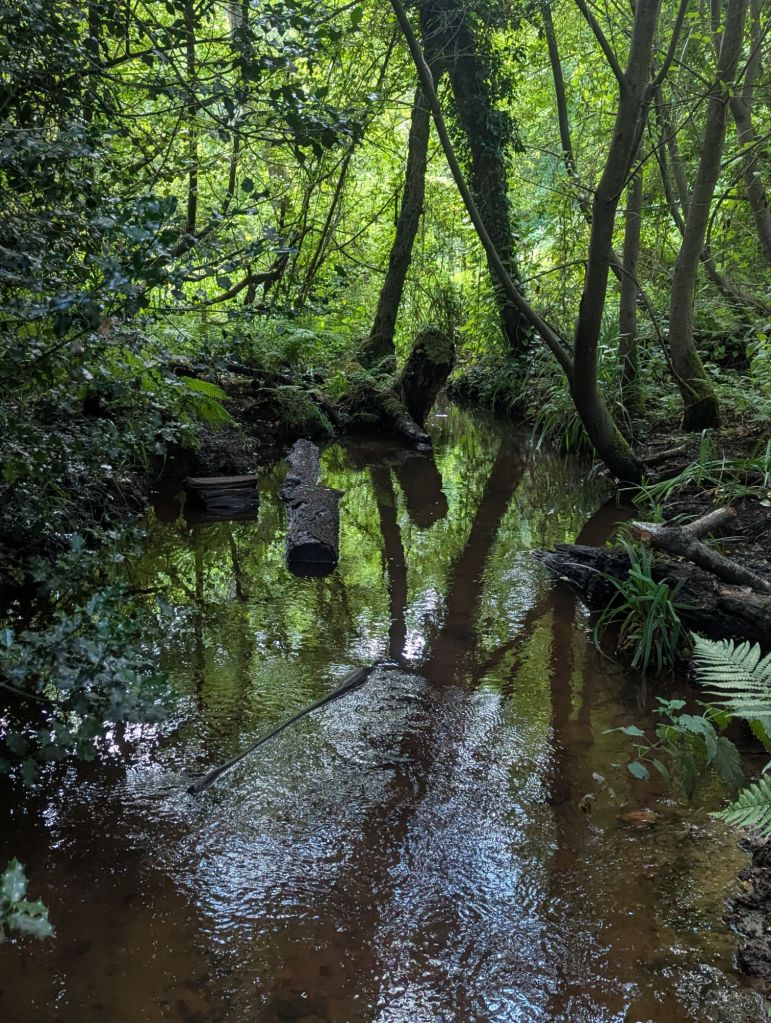
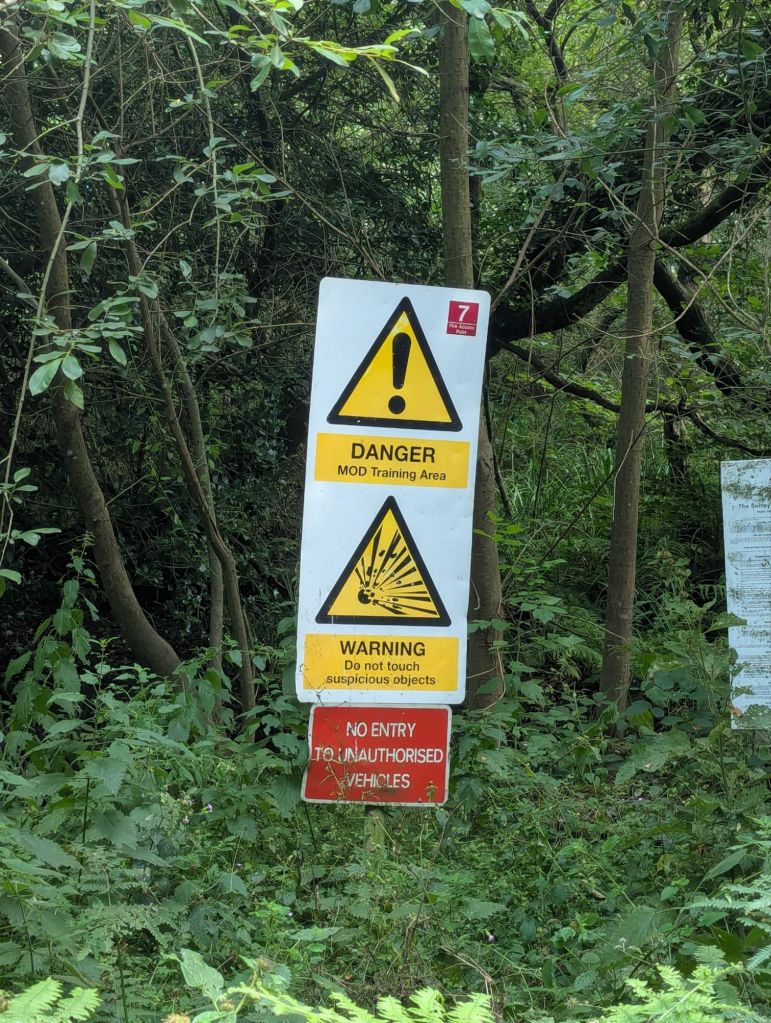
    This area was rich with life: downy birch, silver birch, Scots pine, gorse, oak, and majestic willows trailing along a river far below the sandy paths. I followed some steep, winding trails down to the river’s edge, where rope swings hung from branches, signs of children playing over the years. These joyful spots, though, were marred by patches of litter. A quiet reminder of the responsibility we all share in caring for these spaces.

    Climbing back to the main path, I spotted a buzzard soaring over the field across the river. Curious to know what else was around, I opened the Merlin app. It identified a chiffchaff, stonechat, wren, and the ever-present wood pigeon. I’m often surprised by how much more alive the woods feel when I slow down enough to listen.

    Nearing the edge of the square, I noticed what looked like a campsite, something that hadn’t shown up on any maps. As I got closer, it revealed itself to be a scout camp, complete with a fire engine parked on the track and children excitedly exploring it.

    Heading back, I planned to cross an open heath but soon encountered tents, generators, and vehicles. As I approached, a man on security duty explained that I’d stumbled onto a film set. The low tents suggested a fantasy-style camp scene, and while it blocked my intended route, it added an unexpected magic to the day.

    The detour briefly took me into neighbouring woodland before I rejoined the original square. Near the path’s edge, three porta-loos lay oddly overturned a surreal sight among the trees. From there, I looped back toward the car park.

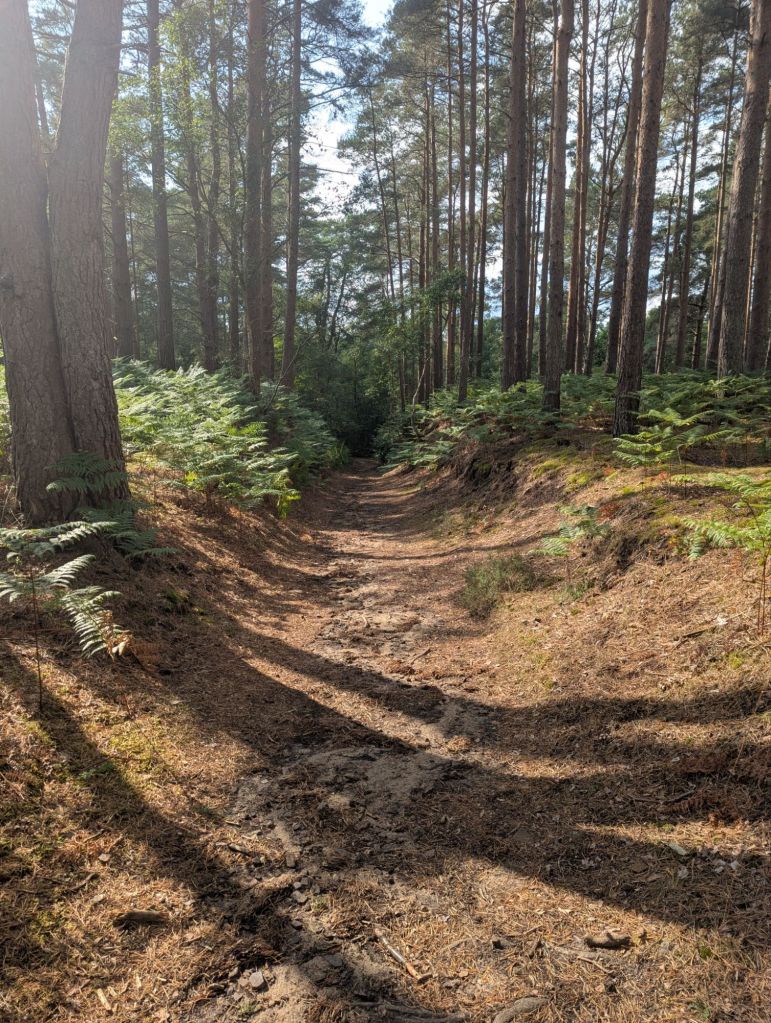
    As I walked, I was reminded how fragmented and layered our landscapes are stitched together by private, military and community-owned spaces, each shaping how nature is allowed to thrive or falter. While some areas were fenced off or degraded, others like the MOD land offered unexpected biodiversity havens. It’s a quiet paradox: land set aside for one reason can end up protecting what is wild.

    But without a joined-up approach, these pockets risk becoming isolated fragments floating in a patchwork with no real continuity. Who owns the land, and how they choose to steward it, matters deeply. It’s not just about access, but about long-term care, connection, and intention.


    If this sparks your interest, The Lie of the Land by Guy Shrubsole is a powerful and accessible read exploring who owns the land in England and what that means for nature, access, and equity.

    Walks like this remind me that mindful exploration isn’t just about seeing more it’s about noticing what shapes the land we move through. Listening not only for birdsong but for the stories beneath our feet.

    Have you ever stumbled across something unexpected while walking? Or noticed how land ownership changes what grows, thrives or disappears?

  • Walking the North Downs Way: A Journey Through Time, Friendship, and Renewal

    Walking the North Downs Way: A Journey Through Time, Friendship, and Renewal

    A First Taste of Freedom

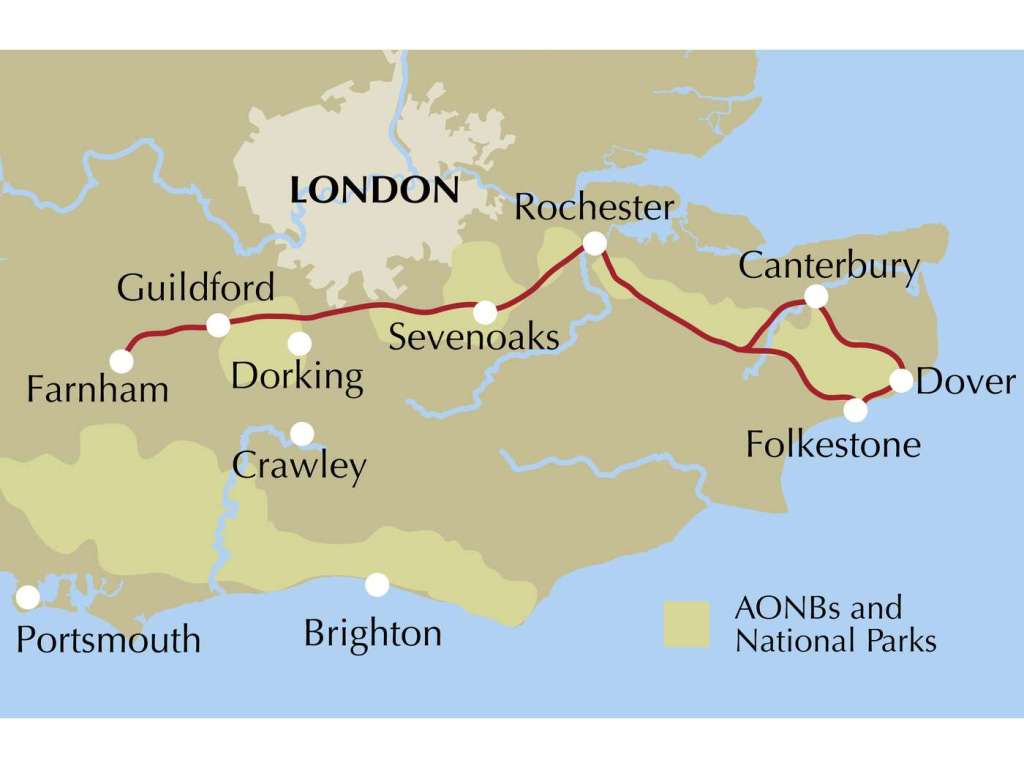
    I started walking the North Downs Way when I was still in school with a friend. It felt like a real adventure getting to Farnham by train and starting a two-night walk to Box Hill. We weren’t very prepared, using a ramshackle collection of old camping gear and an old tarp as our shelter. But we had an amazing couple of days, getting lost, trying to cook food, and putting up the shelter. It was real freedom for a young school kid, even with feet full of blisters from ill-fitted boots.

    Returning with New Eyes

    Years later, I returned to the trail with another kindred spirit. We decided to restart the journey so they could begin it as I had. This time, we were more prepared. With several walking and mountaineering trips between us, we had lighter gear, better boots, and a clearer sense of direction. We covered the route more quickly between Farnham, through Guildford, and onto Box Hill. The section was rich with forest paths, stunning views, and historic pillboxes scattered along the route. We still used a tarp shelter, setting up camp after dark and disappearing again early in the morning.

    Over several years, we completed more two-day sections in this way. Quick, joyful bursts that focused on mileage, camaraderie, and shared laughs, often ending with a local pub. One memorable night involved stumbling into a beer festival and a late-night campsite scramble.

    Walking as Medicine

    After a period of life challenges, I felt the pull to return again, but this time alone. What began as a trail walked in youth and adventure had become something deeper: a space for healing, reflection, and reconnection.

    With the trail’s good travel connections, I began walking day sections. I planned shorter routes with time to stop and soak in the experience. There were moments of slow, meditative walking, just listening and sensing, and often a feeling of merging with the surroundings. These solitary walks gave me new perspective and a sense of peace I hadn’t realised I needed.

    Eventually, I reached Canterbury. Though the trail continues, this point felt like a natural and symbolic place to pause: a full-circle moment that brought me back to a centre point in myself.

    Following in Ancient Footsteps

    Much of the North Downs Way aligns with the historic Pilgrims’ Way, an ancient route said to have stretched from Winchester to Canterbury which are two significant cathedral cities. While the term ‘Pilgrims’ Way’ was popularised during the Victorian era, many believe it traces a route walked for centuries by those journeying to the shrine of Thomas Becket at Canterbury Cathedral.

    This connection adds another layer of reflection to the trail. Walking this path isn’t just a scenic experience, it’s also a way of treading ground steeped in story and significance. For modern pilgrims, spiritual seekers, or those simply curious about deeper journeys, this link can transform a long-distance path into a soulful rite of passage.

    Other pilgrims’ routes like the Via Francigena, which stretches from Canterbury all the way to Rome, also share this sacred starting point, reminding us that Canterbury is not an end, but often a beginning.

    On the Evolving Nature of a Journey

    One thing that’s stood out across the years is how age and maturity reshape the journey. In my youth, walks were energetic and driven by challenges. More about how far, how fast, how wild. As I grew older, the same path invited a gentler approach. Walking became more about connection than conquest; more about the journey than the destination.

    A Note on Wild Camping

    While wild camping is technically not allowed on the North Downs Way, we made every effort to follow leave-no-trace principles. Arriving late, departing early, and never leaving a mark. Although I can’t advocate it for legal reasons, I do acknowledge its role in our experience.

    Interested in Walking the North Downs Way?

    If anyone is interested or has questions, feel free to get in touch. In the coming months, I plan to offer introductory walking sessions from Farnham to Guildford for those looking to begin their own journey but need a little extra confidence to get started.

    Further Resources

  • The Evolving Flâneur: From Urban Streets to Mindful Trails

    A Brief Stroll Through History

    The flâneur first appeared in 19th-century Paris, a figure caught between observer and participant, strolling aimlessly through boulevards, arcades and alleyways. Made famous by writers like Charles Baudelaire and later thinkers such as Walter Benjamin, the flâneur was not simply a loiterer, but a thoughtful witness to the pulse of the modern city. A connoisseur of the everyday. A collector of impressions.

    While the flâneur was traditionally a solitary, often male figure drifting through the city with a detached gaze, this role has not gone without critique. His ability to wander freely was, in many ways, a product of social privilege, economic freedom, racial invisibility and gender safety.

    What interests us at Mindful Trails is how this idea can evolve: from the disconnected observer to the eco-flâneur, someone who notices not only people and architecture but also lichen on a wall, the call of a blackbird, or the dew on the web.

    In that sense, flânerie becomes more than aesthetic, it becomes relational. No longer a passive drifting, but a quiet form of belonging. A letting go of the self-as-separate. This has echoes of Buddhist mindfulness: walking not to consume, but to notice. Not to detach from the world, but to realise we were never separate from it in the first place.

    For the flâneur, the walk was the point. The destination was irrelevant. What mattered was immersion in crowds, architecture, shadows, rhythms. This was slow observation as a quiet act of rebellion against speed, structure and productivity.

    Expanding the Practice: From Streets to Streams

    While the original flâneur wandered city streets, the spirit of flânerie can go anywhere the mind and feet are willing to follow. A country lane. A patch of waste ground. A woodland path. A canal towpath. A shoreline.

    At Mindful Trails, we’ve found that this same attentive wandering applies beautifully to natural or hybrid landscapes. Noticing the curl of a leaf. The chatter of jackdaws. The cracks in a paving stone. The worn footpath trodden by centuries of quiet footsteps. This kind of mindful wandering softens the boundary between ‘urban’ and ‘wild.’

    In fact, nature is never truly absent. The moss between bricks, the gull above the car park, the tree pushing up through the pavemen. Flânerie, when approached with mindfulness, invites us to notice that nature is everywhere if we slow down enough to see it.


    Wandering as Resistance

    In a world that values speed, productivity and goals, to walk slowly and observe without purpose is an act of quiet resistance. It reconnects us with our senses. It opens the door to creativity, curiosity and calm.

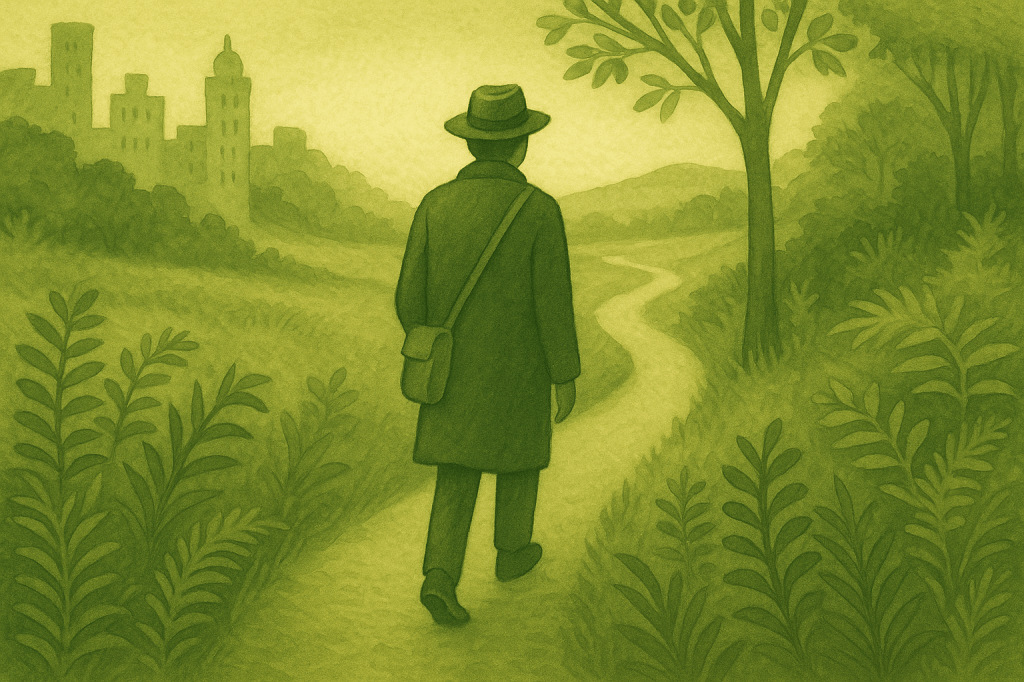
    The mindful flâneur is not necessarily a romantic figure in a long coat anymore. They are a parent on a slow walk with a child. A solo explorer taking time to watch the light shift through trees. A traveller who chooses to walk between villages rather than rush through them.

    Slowing Into Connection

    One thing I’ve noticed on my own walks is how presence changes pace. The more I slow down, the more my body begins to sync with the rhythm of the place, be it woodland, coast, or quiet backstreet. My feet respond to the terrain, my breath settles with the breeze, and my awareness gently shifts from self to surroundings.

    It’s as if I’m no longer passing through a landscape, but becoming part of it.

    In this way, the flâneur evolves from someone observing life, to someone rejoining it. Moving from a human-centred gaze to a more humble noticing of all life. The moss on the stone. The red kite calling above. The silence between bird song.

    This, for me, is where flânerie meets mindful trails. Where wandering becomes belonging.

    A Mindful Trails Invitation

    You don’t need Parisian arcades or a curated route. You just need time, awareness and a willingness to follow your feet. Whether you’re walking through a village high street the edge of a woodland, or the hinterland of the edgelands a term coined by Marion Shoard, the flâneur mindset invites you to ask:

    What do I notice when I stop trying to get anywhere fast?

    • What do I notice when I stop trying to get anywhere fast?
    • What’s usually invisible but now stands out?
    • What textures, sounds or patterns pull me in?

    At Mindful Trails, we think this spirit of exploration belongs to everyone, children and adults alike. It’s not about covering ground, but deepening it.

    So the next time you go out for a walk, try leaving your destination behind. Wander slowly. Let your surroundings speak. You might be surprised by what you find.

    🌍 Further Wandering: Related Resources


    Slow Ways – A grassroots initiative mapping walking routes between towns and cities across the UK. Perfect for slow, mindful journeys that mirror the spirit of the flâneur.

    Street Wisdom – An organisation offering guided urban walks to unlock insight and creativity through attention and presence.