‘Sometimes, a simple lunchtime walk becomes something more.‘
During a particularly difficult period in my career, I found myself pulled toward green spaces in search of a reset. These solo escapes, sometimes just 20 minutes long became something like medicine. A picnic bench under a tree. A quiet trail just past the last row of houses. A patch of forest where you could feel the day exhale.
What started as a breath of fresh air turned into a quiet ritual. I began to spend longer in these outdoor pockets of calm, and on some days, even joined video meetings from woodland clearings or grassy meadows. To my surprise, the people on the other end of the call noticed too the sense of calm, the stillness. It became something I shared, not just something I needed.
I also brought a sense of curiosity to these micro adventures. Using the Merlin Bird ID app to learn birdsong, or plant ID apps to explore what was growing around me, gave these moments texture and meaning. It wasn’t about covering ground it was about noticing the ground beneath me.
These mindful moments reminded me:
That we don’t always need big plans to feel grounded
That nature, even in small doses, can be powerful
That connection can be found just a few steps outside the usual routine
3 Ways to Find a Mindful Moment Near Work
1. Go solo and slow. Take 15–30 minutes to explore nearby green space without a goal. Walk slowly, notice your breath, your senses, and your surroundings.
2. Pack a picnic (even if it’s small). A sandwich on a shaded bench can feel like a full reset. Eating slowly, in fresh air, helps you reconnect with your body and the moment.
3. Let curiosity guide you. Try an app like Merlin or Seek to explore the natural world around you. Notice the birds, plants, textures, and weather patterns you often miss.
Final Thought
You don’t have to go far to go deep. Whether it’s a patch of trees near the office or a meadow tucked behind a housing estate, these small moments can shift your perspective and your day.
If you’ve found your own micro escapes near work, we’d love to hear them.
The flâneur first appeared in 19th-century Paris, a figure caught between observer and participant, strolling aimlessly through boulevards, arcades and alleyways. Made famous by writers like Charles Baudelaire and later thinkers such as Walter Benjamin, the flâneur was not simply a loiterer, but a thoughtful witness to the pulse of the modern city. A connoisseur of the everyday. A collector of impressions.
While the flâneur was traditionally a solitary, often male figure drifting through the city with a detached gaze, this role has not gone without critique. His ability to wander freely was, in many ways, a product of social privilege, economic freedom, racial invisibility and gender safety.
What interests us at Mindful Trails is how this idea can evolve: from the disconnected observer to the eco-flâneur, someone who notices not only people and architecture but also lichen on a wall, the call of a blackbird, or the dew on the web.
In that sense, flânerie becomes more than aesthetic, it becomes relational. No longer a passive drifting, but a quiet form of belonging. A letting go of the self-as-separate. This has echoes of Buddhist mindfulness: walking not to consume, but to notice. Not to detach from the world, but to realise we were never separate from it in the first place.
For the flâneur, the walk was the point. The destination was irrelevant. What mattered was immersion in crowds, architecture, shadows, rhythms. This was slow observation as a quiet act of rebellion against speed, structure and productivity.
Expanding the Practice: From Streets to Streams
While the original flâneur wandered city streets, the spirit of flânerie can go anywhere the mind and feet are willing to follow. A country lane. A patch of waste ground. A woodland path. A canal towpath. A shoreline.
At Mindful Trails, we’ve found that this same attentive wandering applies beautifully to natural or hybrid landscapes. Noticing the curl of a leaf. The chatter of jackdaws. The cracks in a paving stone. The worn footpath trodden by centuries of quiet footsteps. This kind of mindful wandering softens the boundary between ‘urban’ and ‘wild.’
In fact, nature is never truly absent. The moss between bricks, the gull above the car park, the tree pushing up through the pavemen. Flânerie, when approached with mindfulness, invites us to notice that nature is everywhere if we slow down enough to see it.
Wandering as Resistance
In a world that values speed, productivity and goals, to walk slowly and observe without purpose is an act of quiet resistance. It reconnects us with our senses. It opens the door to creativity, curiosity and calm.
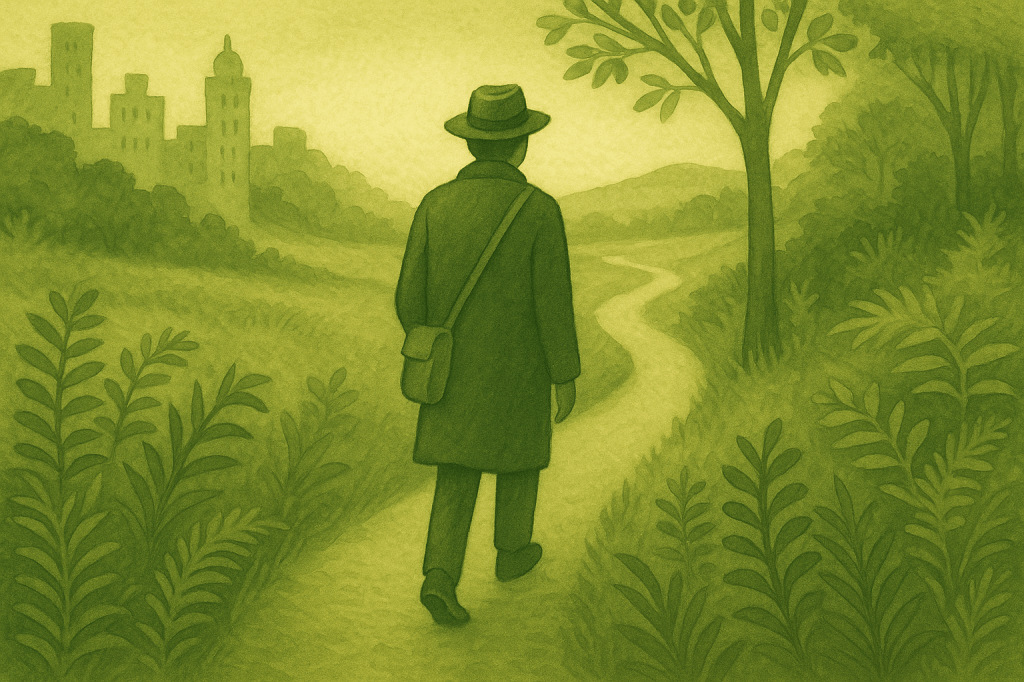
The mindful flâneur is not necessarily a romantic figure in a long coat anymore. They are a parent on a slow walk with a child. A solo explorer taking time to watch the light shift through trees. A traveller who chooses to walk between villages rather than rush through them.
Slowing Into Connection
One thing I’ve noticed on my own walks is how presence changes pace. The more I slow down, the more my body begins to sync with the rhythm of the place, be it woodland, coast, or quiet backstreet. My feet respond to the terrain, my breath settles with the breeze, and my awareness gently shifts from self to surroundings.
It’s as if I’m no longer passing through a landscape, but becoming part of it.
In this way, the flâneur evolves from someone observing life, to someone rejoining it. Moving from a human-centred gaze to a more humble noticing of all life. The moss on the stone. The red kite calling above. The silence between bird song.
This, for me, is where flânerie meets mindful trails. Where wandering becomes belonging.
A Mindful Trails Invitation
You don’t need Parisian arcades or a curated route. You just need time, awareness and a willingness to follow your feet. Whether you’re walking through a village high street the edge of a woodland, or the hinterland of the edgelands a term coined by Marion Shoard, the flâneur mindset invites you to ask:
What do I notice when I stop trying to get anywhere fast?
What do I notice when I stop trying to get anywhere fast?
What’s usually invisible but now stands out?
What textures, sounds or patterns pull me in?
At Mindful Trails, we think this spirit of exploration belongs to everyone, children and adults alike. It’s not about covering ground, but deepening it.
So the next time you go out for a walk, try leaving your destination behind. Wander slowly. Let your surroundings speak. You might be surprised by what you find.
🌍 Further Wandering: Related Resources
Slow Ways – A grassroots initiative mapping walking routes between towns and cities across the UK. Perfect for slow, mindful journeys that mirror the spirit of the flâneur.
Street Wisdom – An organisation offering guided urban walks to unlock insight and creativity through attention and presence.




 Mindful Trails